AI
AI Command Centre
AI agents that plan and run research tasks locally, for £0.
- Status
- Working prototype
- Built with
- Cursor, Claude Code
- Stack
- TypeScript, Node.js, Fastify, SQLite, React, Ollama local models
- Timeframe
- Aug – Oct 2026
In 30 seconds
- The problem
- Most AI tools are one chat window and one model. Every question costs money or sends data to the cloud.
- What it does
- I type an objective. A planner splits it into tasks, several agents run them in parallel on models running on my Mac, and a synthesiser writes one recommendation with a confidence level.
- Where it's at
- Working prototype. The core milestones are done. Critique, approvals and long-term memory are on the roadmap.
Walkthrough
- Enlarge screenshot:
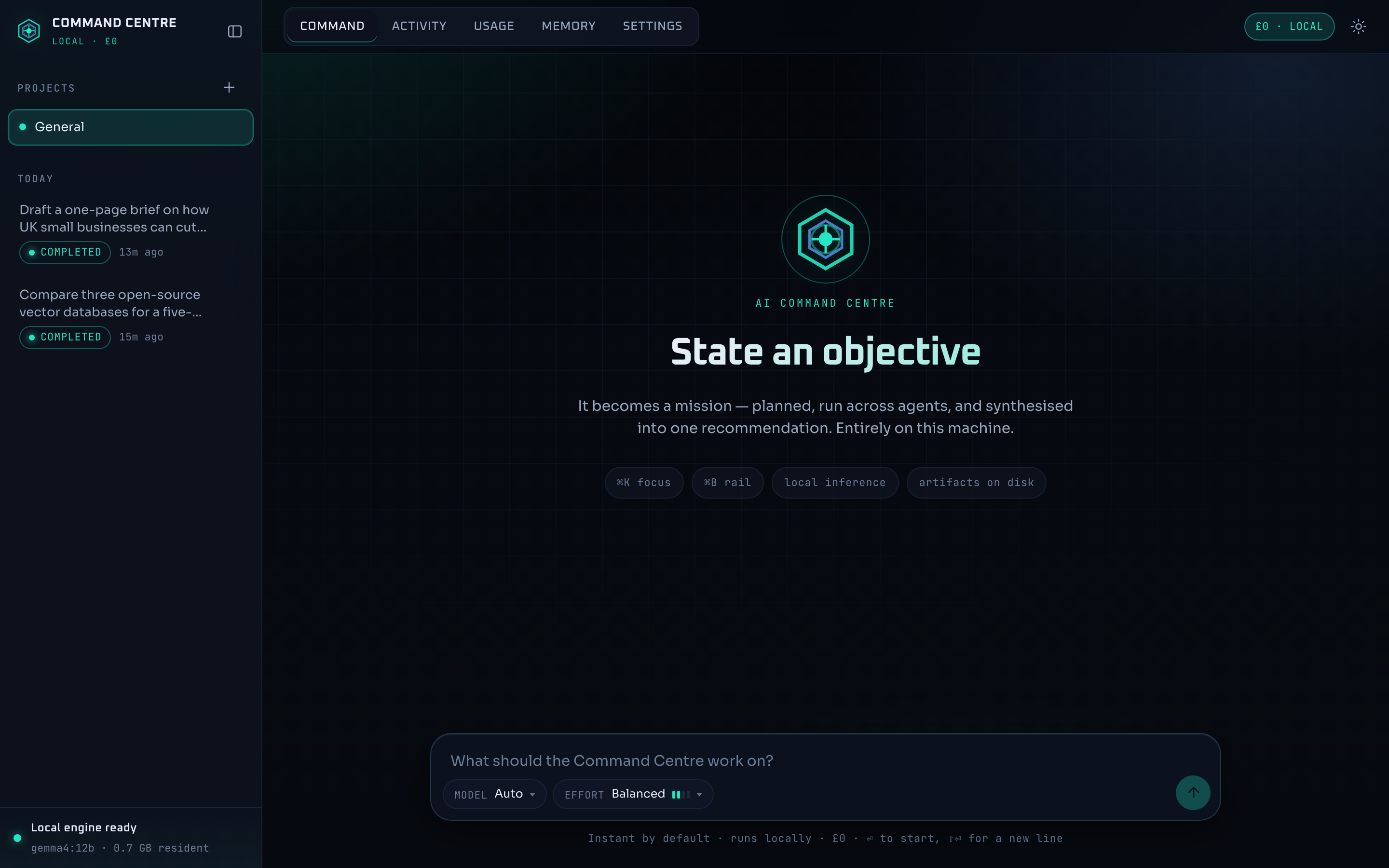
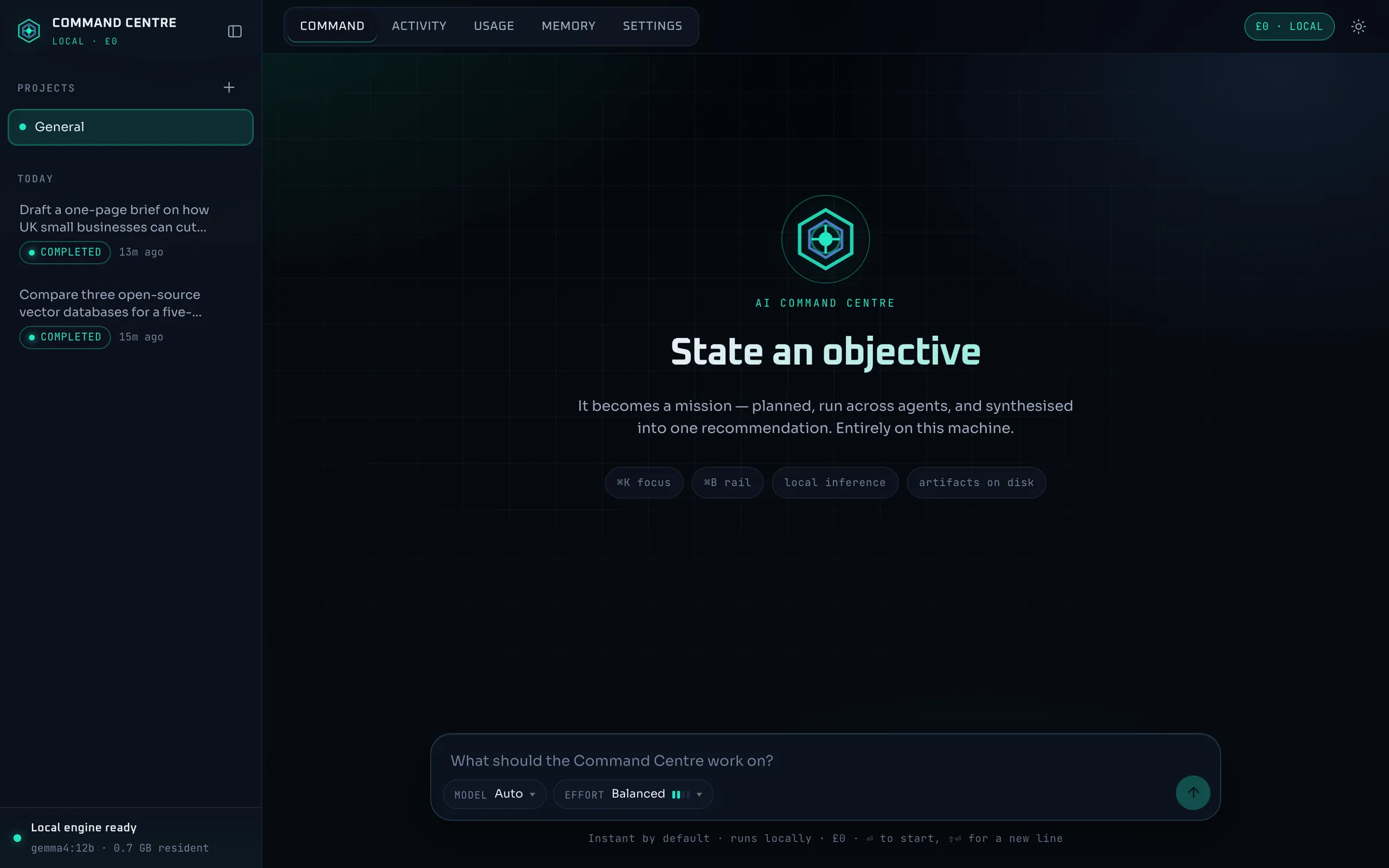
One objective in, with a choice of model and how much effort to spend. - Enlarge screenshot:
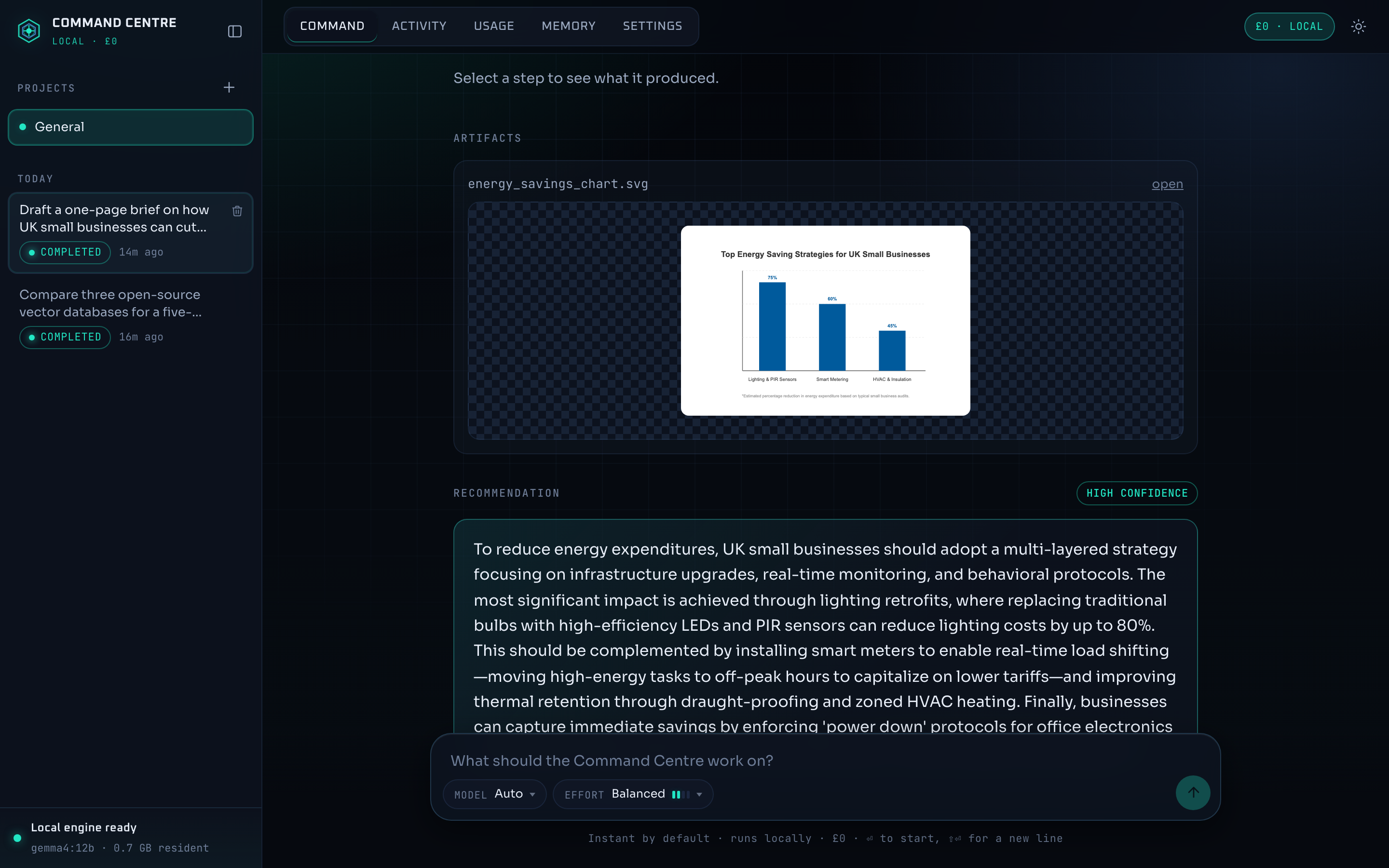
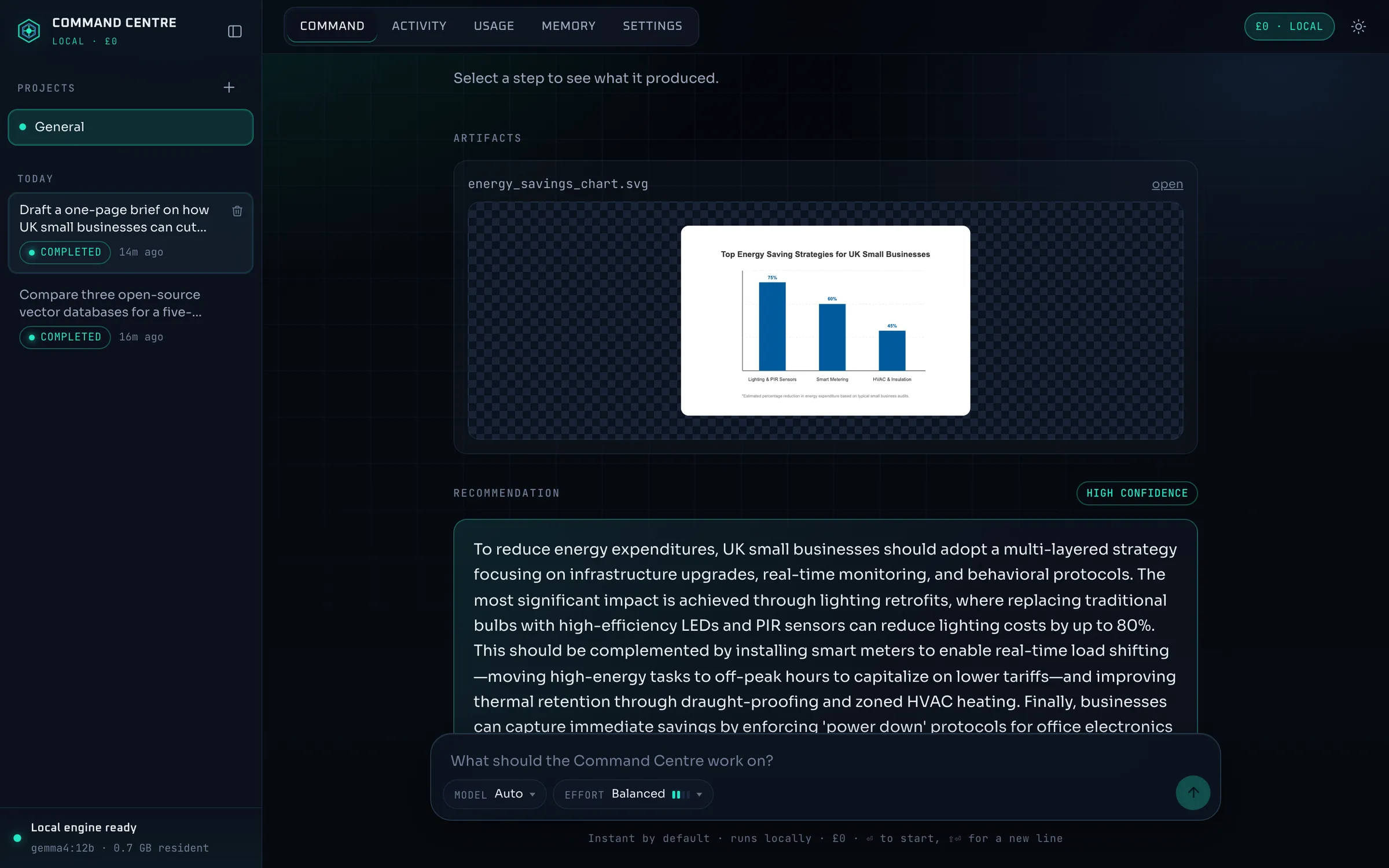
The answer: a chart the maker agent drew itself, and a recommendation with its confidence. Both are AI output from a test mission. - Enlarge screenshot:
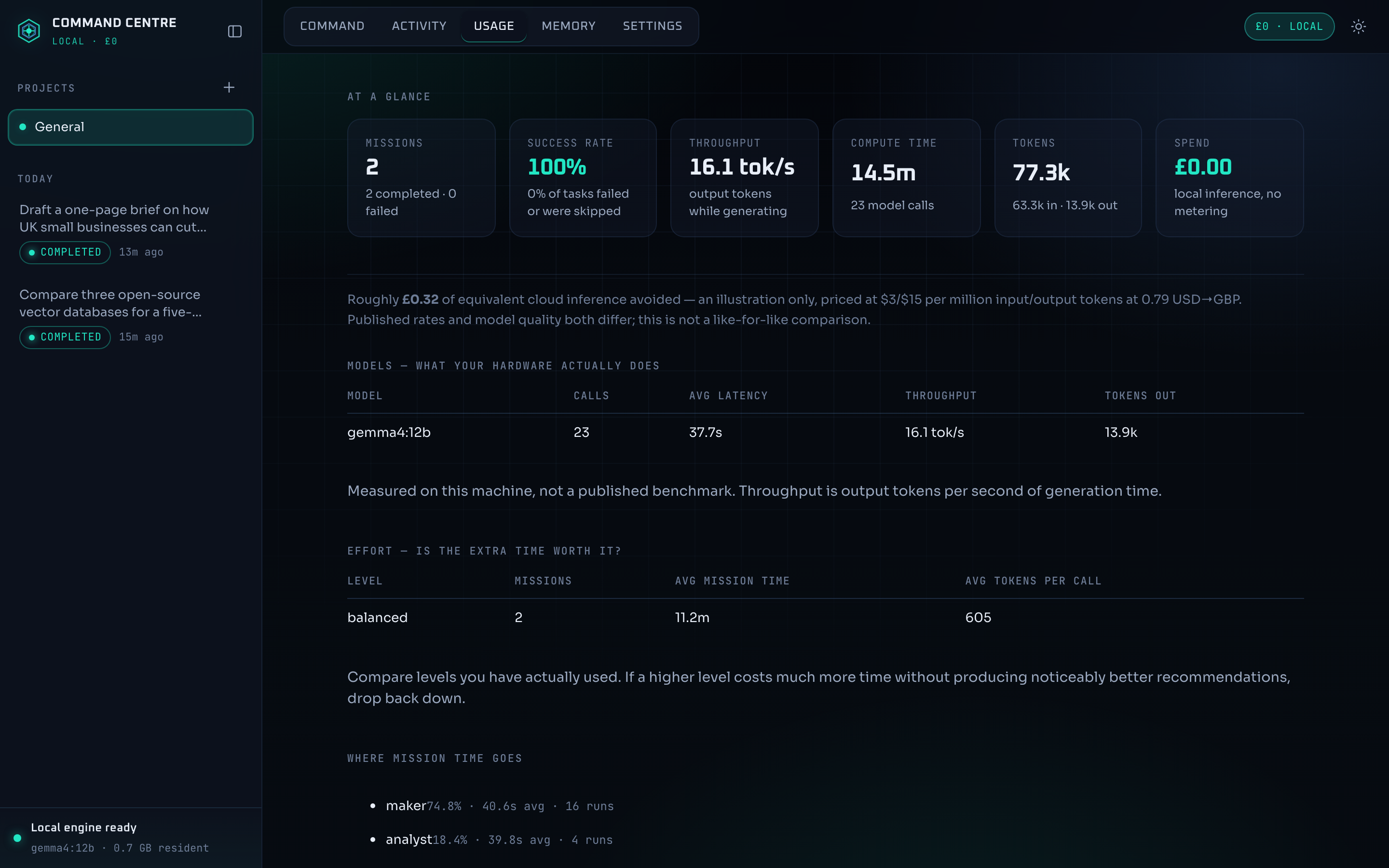
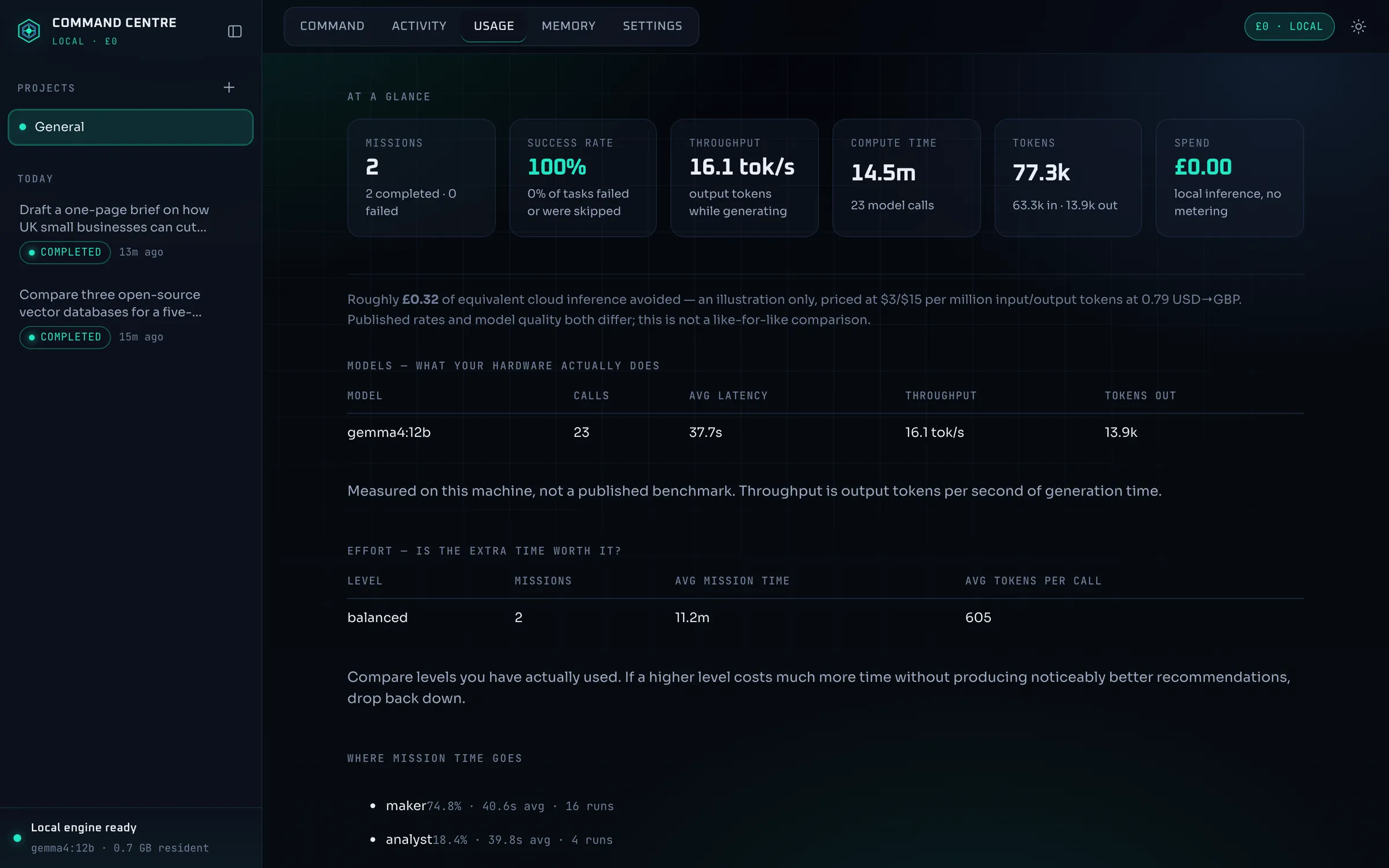
Usage, measured on my Mac: speed, tokens and a spend of £0.00.
How I built it
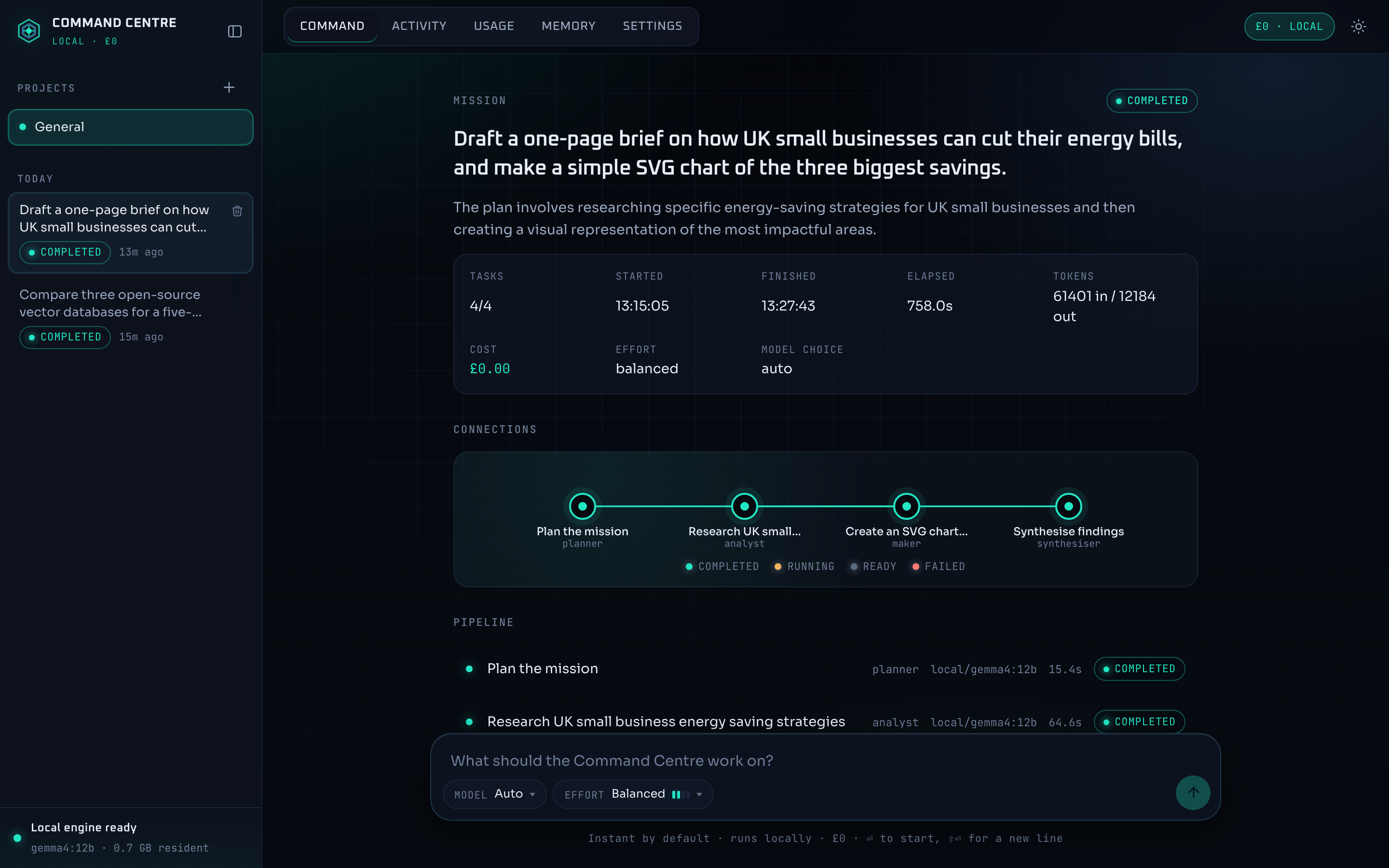
The Command Centre is a mission control for AI agents. I type an objective, such as researching a market or drafting a short report. A planner agent breaks it into tasks and works out which depend on which. Worker agents then run the independent tasks in parallel, and a synthesiser pulls the results into one recommendation with a stated confidence. A maker agent can also write real files, such as a chart or a document, into a sandboxed folder it cannot escape.
Everything runs on local models through Ollama, so there is no API bill and nothing leaves the Mac. A short mission takes about 40 seconds and 3,600 tokens on an 8-billion-parameter model, for £0. Bigger jobs take longer: on the 12-billion-parameter model I use now, a four-agent mission that researched a brief and drew a chart took about 12½ minutes, still for £0. A router picks a model for each task based on what it needs to do. An optional cloud model can be switched on for harder work.
I care more about measured quality than impressions, so the project has an evaluation harness: a fixed set of test missions, scored automatically. When the maker agent was failing, the evals showed it: 0 of 6 test missions produced a file. After the fix it was 6 of 6.
I wrote the specification and the milestone roadmap, chose the models from the eval results, and tested each milestone. The code was written mainly in Cursor, with later work in Claude Code.
What I learned
- Measure, don’t guess. An eval set turns “it feels better” into a number you can defend.
- Local models trade some quality for cost and privacy. Knowing where that trade is worth it is the real decision.
- Orchestration is most of the work. Dependencies, retries and timeouts matter more than any single clever prompt.
- Tokens are the unit of cost, even when the bill is zero. Watching them keeps a system honest.
Why it matters in a sales seat
AI buyers ask about cost per task, speed, how quality is measured and where their data goes. I have had to answer those questions for my own system, with real numbers.