Markets · Data
Meridian
Four connected market terminals for macro, equities and crypto.
- Status
- MacroWorking prototype
- EquitiesWorking prototype
- CryptoIn use
- CommandIn progress
- Built with
- Claude Code, Cursor, Claude models (Opus, Sonnet, Haiku), Gemini as independent reviewer
- Stack
- Python, DuckDB, Streamlit, React, Next.js, TypeScript, Swift Mac wrappers
- Timeframe
- Jun 2026 – present
In 30 seconds
- The problem
- Market data is everywhere, but it rarely answers the question an investor actually asks. What kind of market are we in, and has that changed?
- What it does
- Four apps that score the economy, global equity markets and the crypto cycle against their own history, then bring all three together in one view.
- Where it's at
- Meridian Crypto runs on my Mac every day and records a reading daily. Macro and Equities are working prototypes. Command is in progress.
Try it
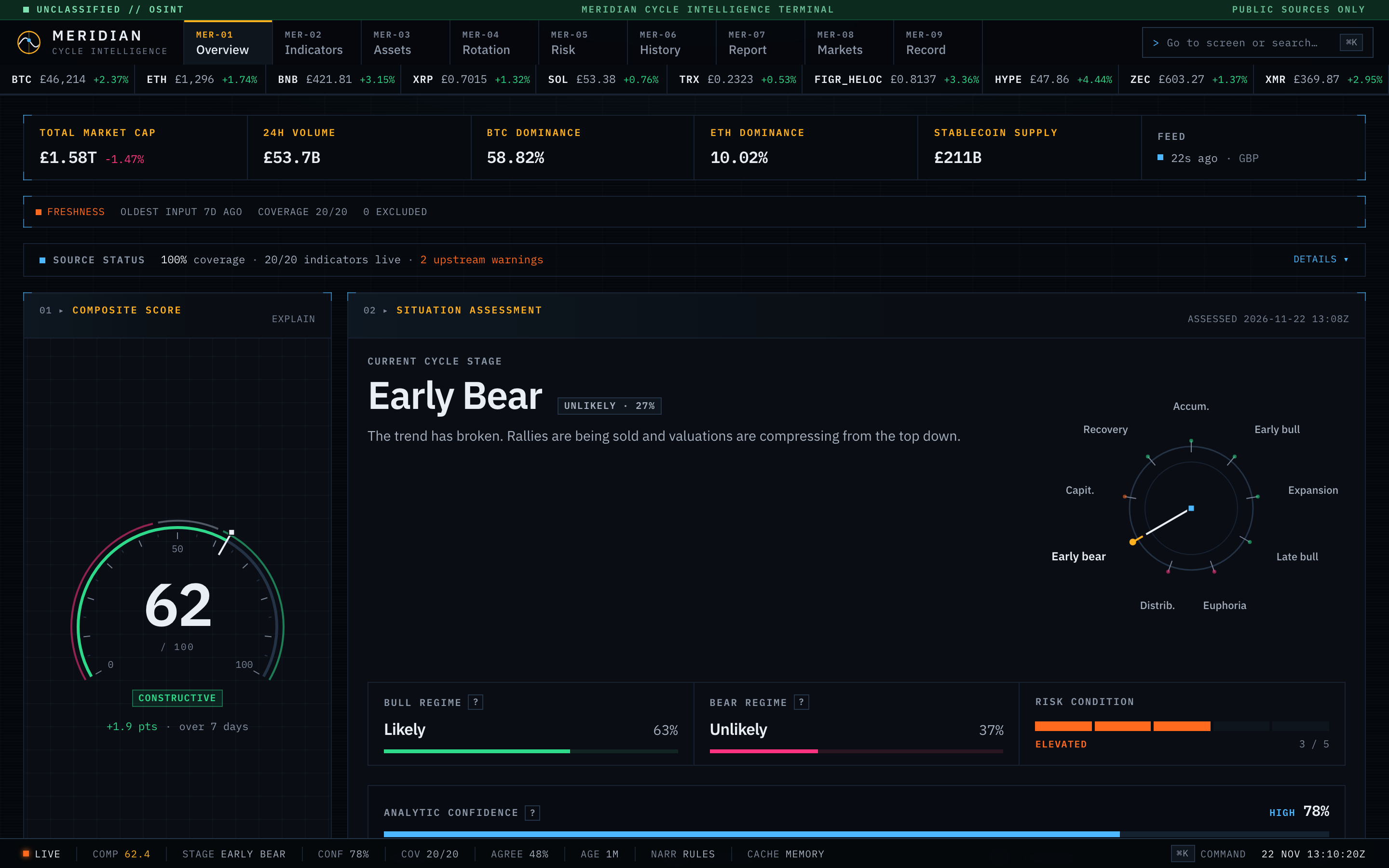
Change the inputs and watch the real scoring engine recalculate the score, the cycle stage and its confidence.
Meridian Crypto cycle engine
Demo running on a saved snapshot of data from 22 November 2026
Real app code · in your browser
Composite score
62/ 100
As recorded
Most likely stage
Early Bear
25% probability
Probability of each cycle stage
- Recovery18%
- Accumulation17%
- Early Bull19%
- Bull Expansion4%
- Late Bull1%
- Euphoria1%
- Distribution3%
- Early Bear25%
- Capitulation11%
Bull or bear regime
Bull 65%Bear 35%
- Confidence
- 78%
- Data coverage
- 100%
- Indicator agreement
- 48%
Switch a data source off (16 indicators)
Simulates an outage. The engine stops counting that indicator, shares its weight among the rest, and lowers its confidence.
This runs the scoring and cycle code from Meridian Crypto, copied into this page, on public data captured on 22 November 2026 at 20:25 UTC. Only openly licensed sources are included. It describes market conditions; it is not investment advice.
Walkthrough
- Enlarge screenshot:
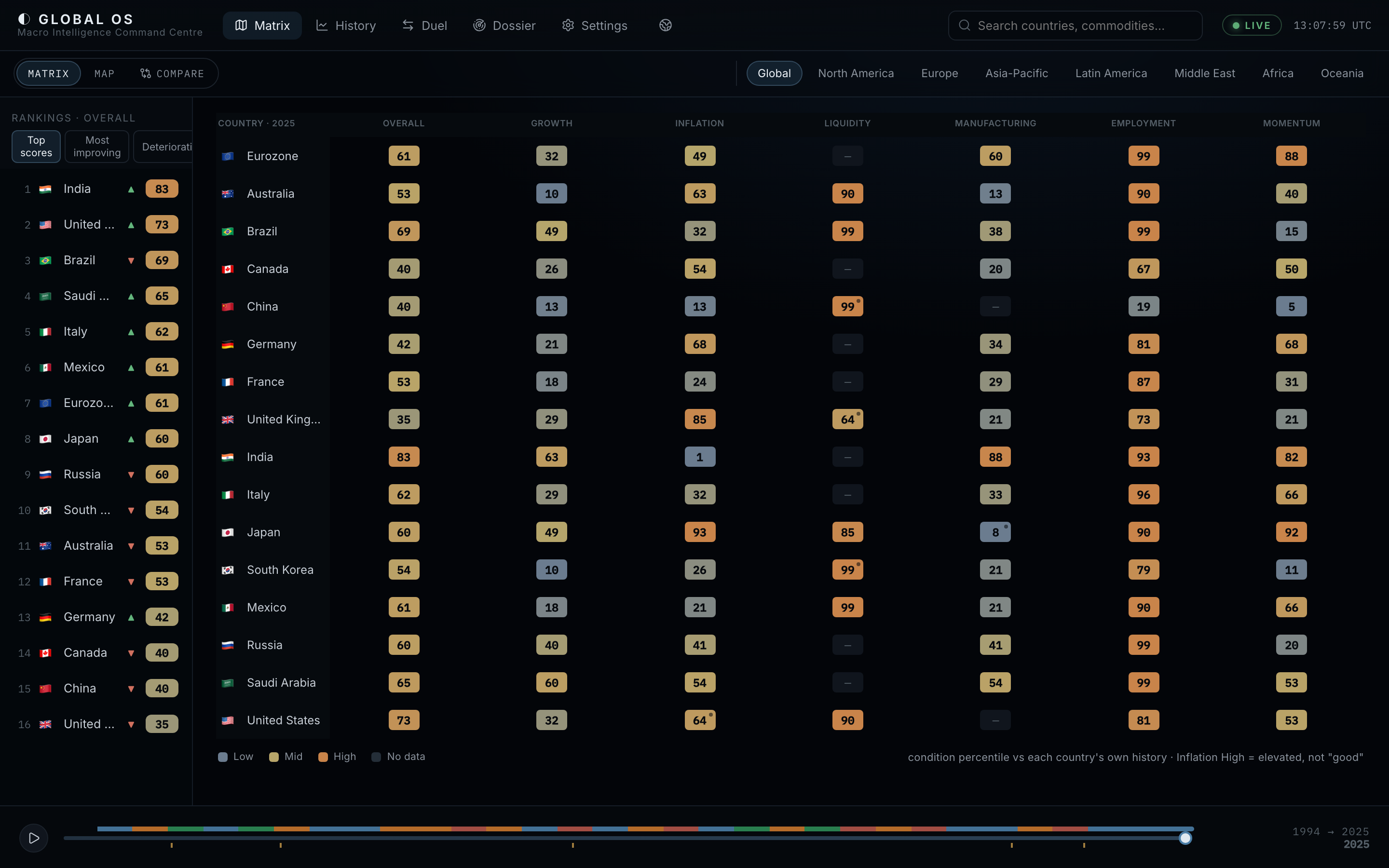
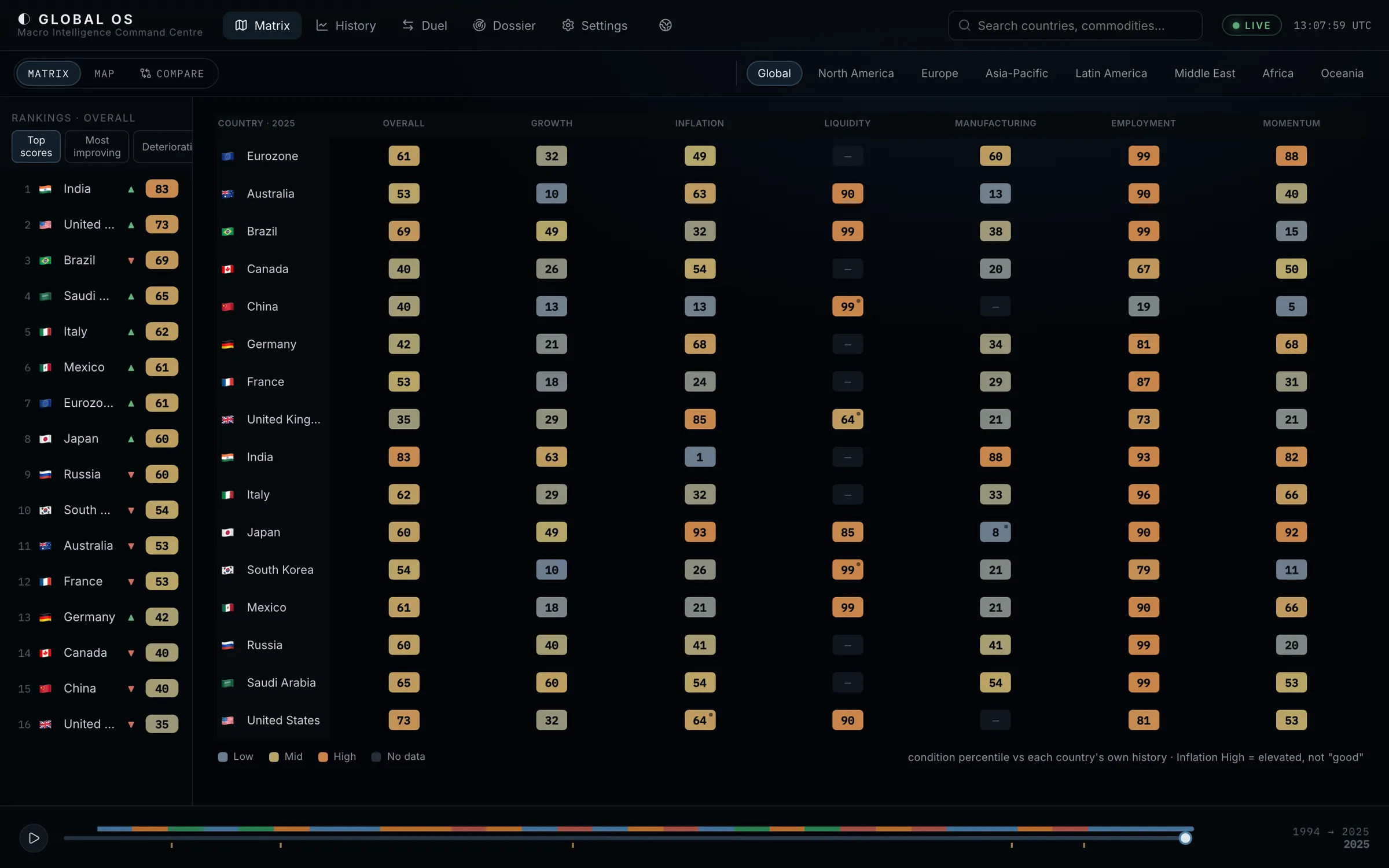
Macro: 15 countries and the Eurozone, each pillar scored against its own history. - Enlarge screenshot:
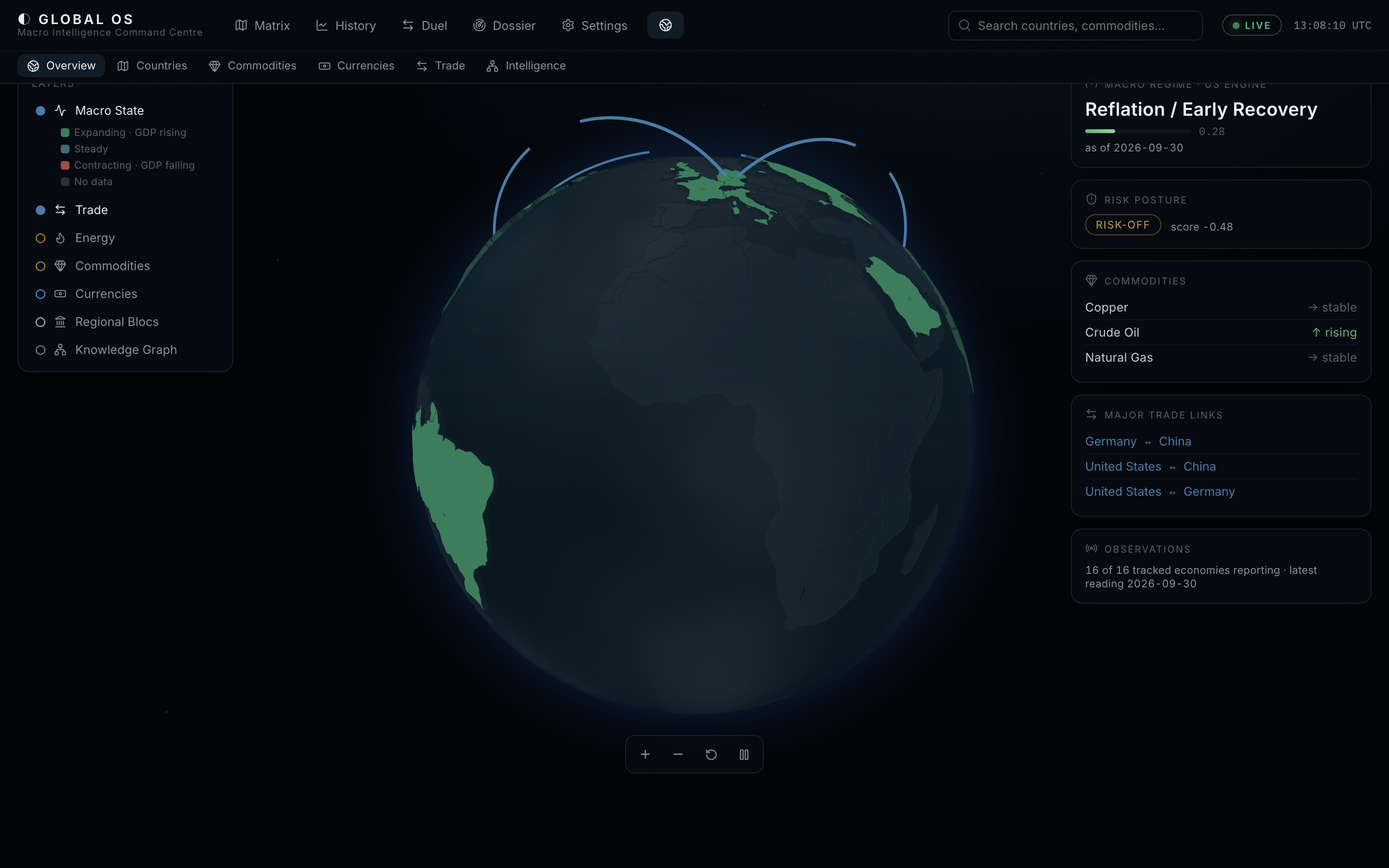
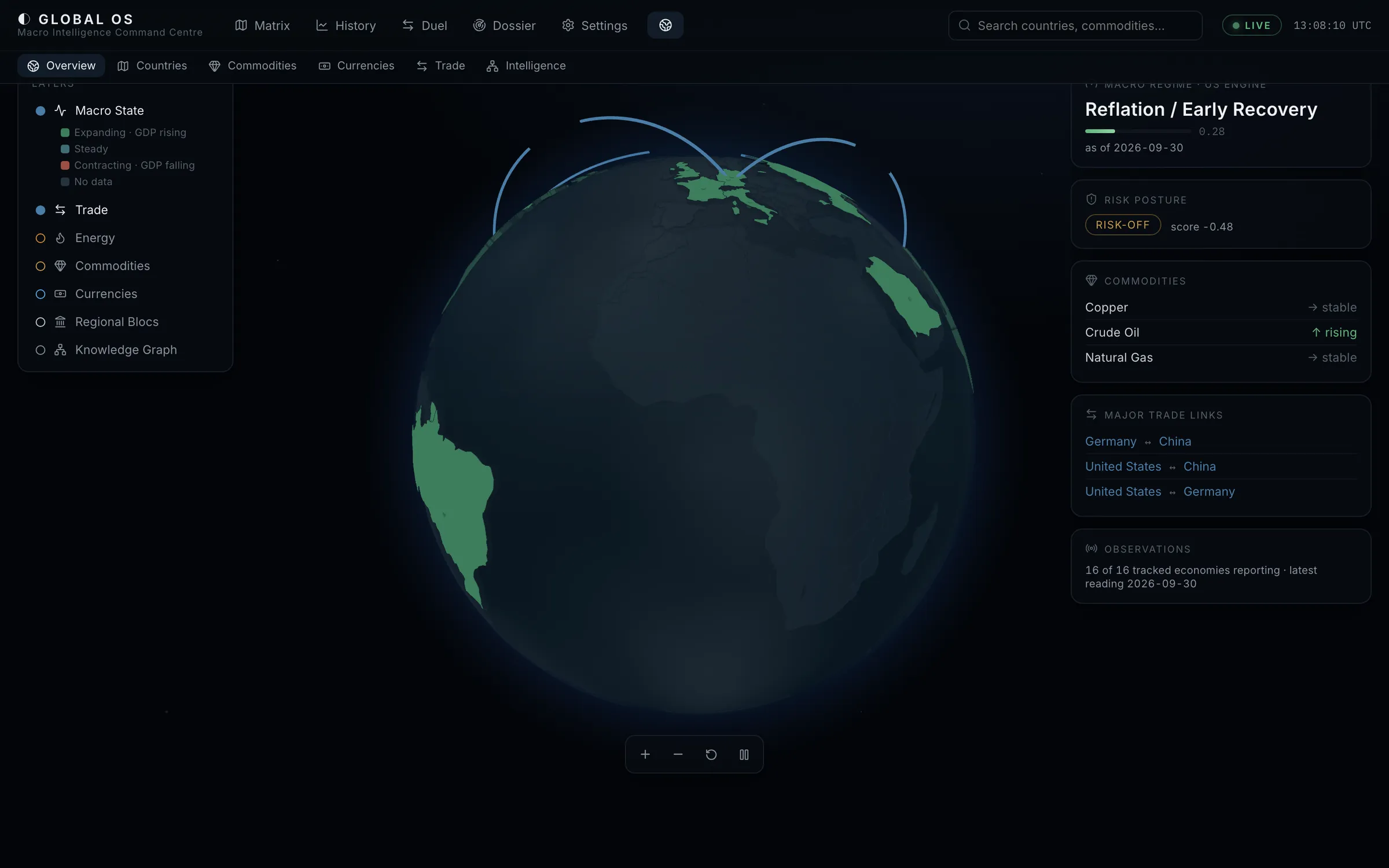
Macro: the globe view, with the current US regime and risk posture. - Enlarge screenshot:
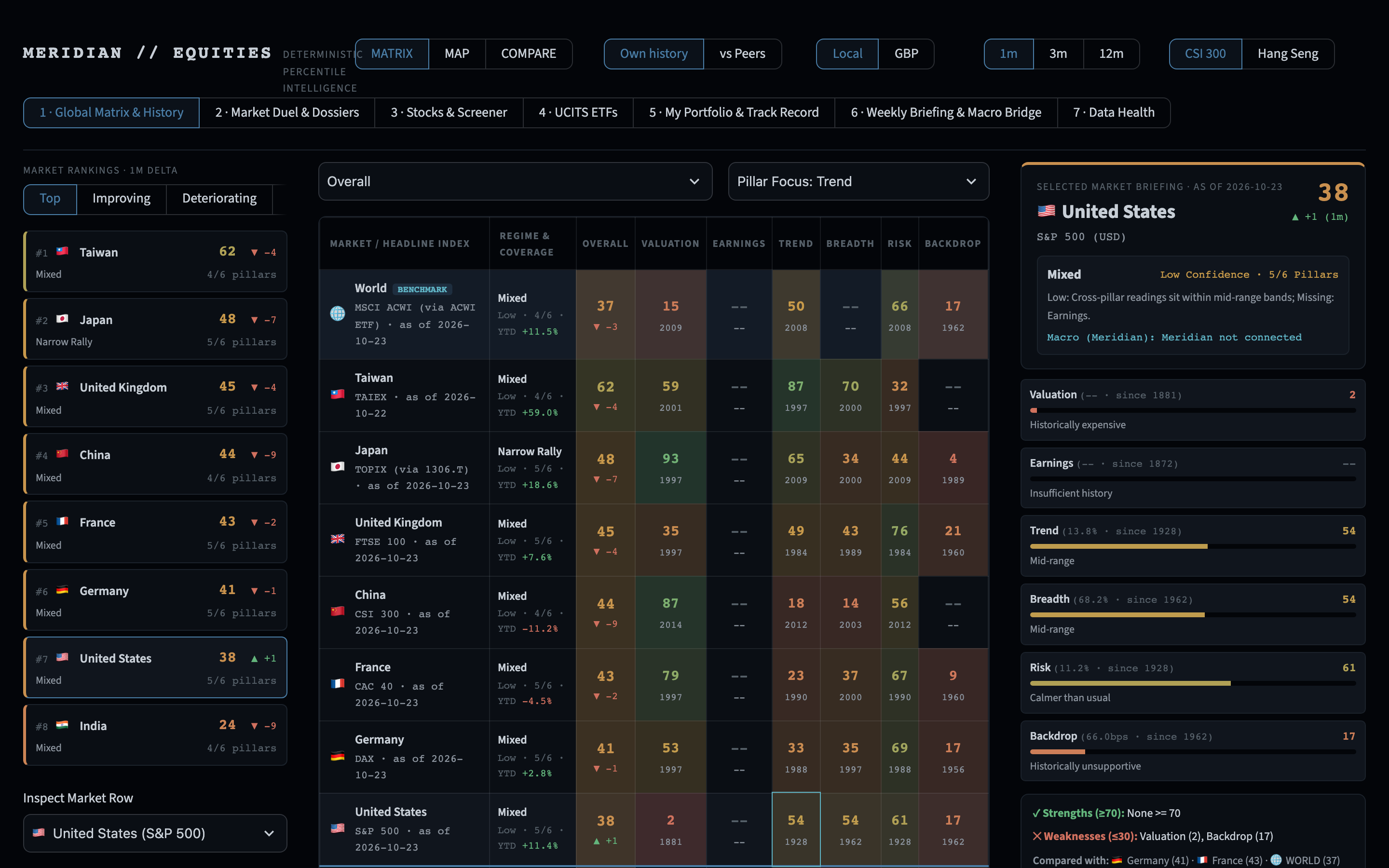
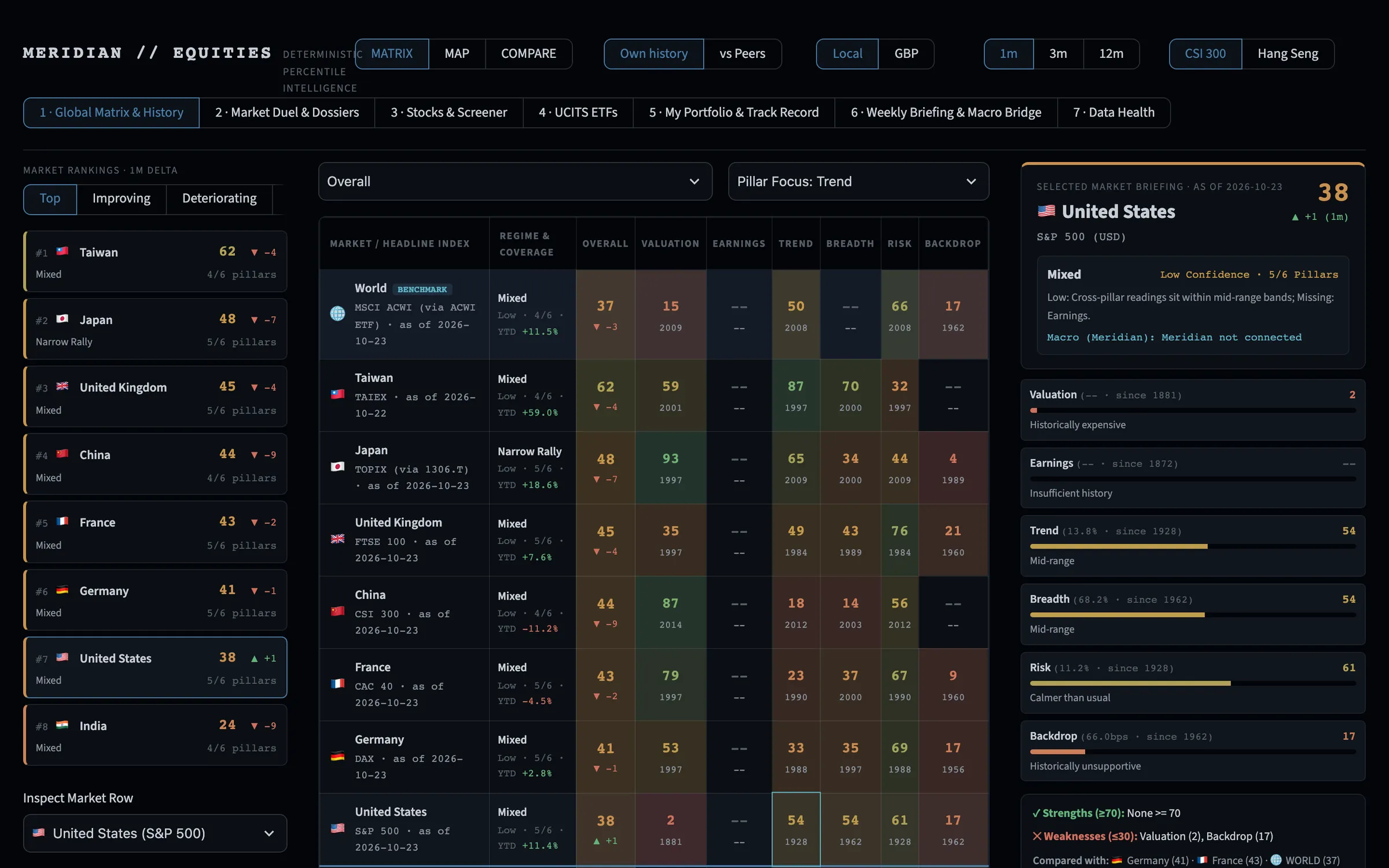
Equities: eight markets scored on valuation, earnings, trend, breadth, risk and backdrop. - Enlarge screenshot:
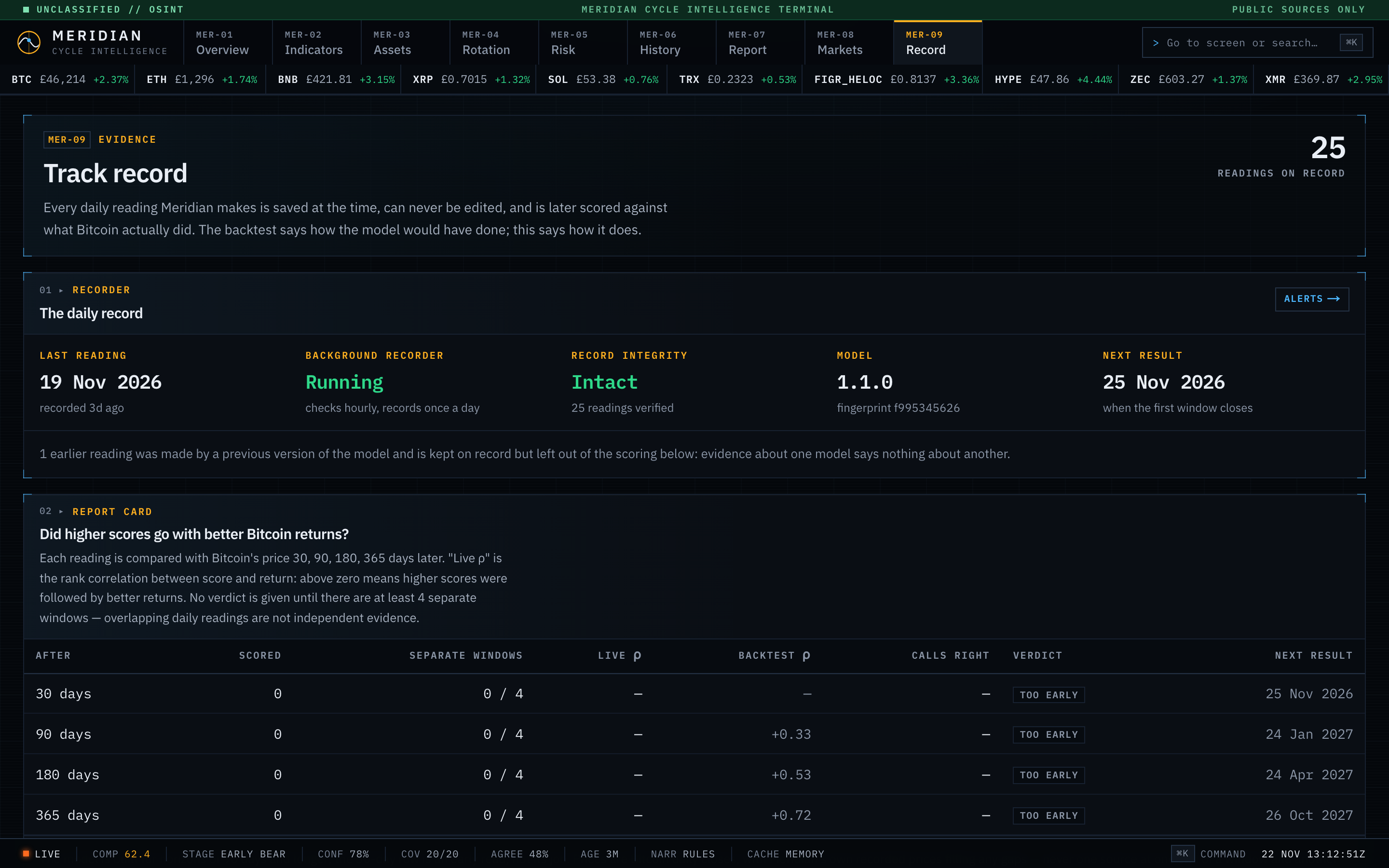
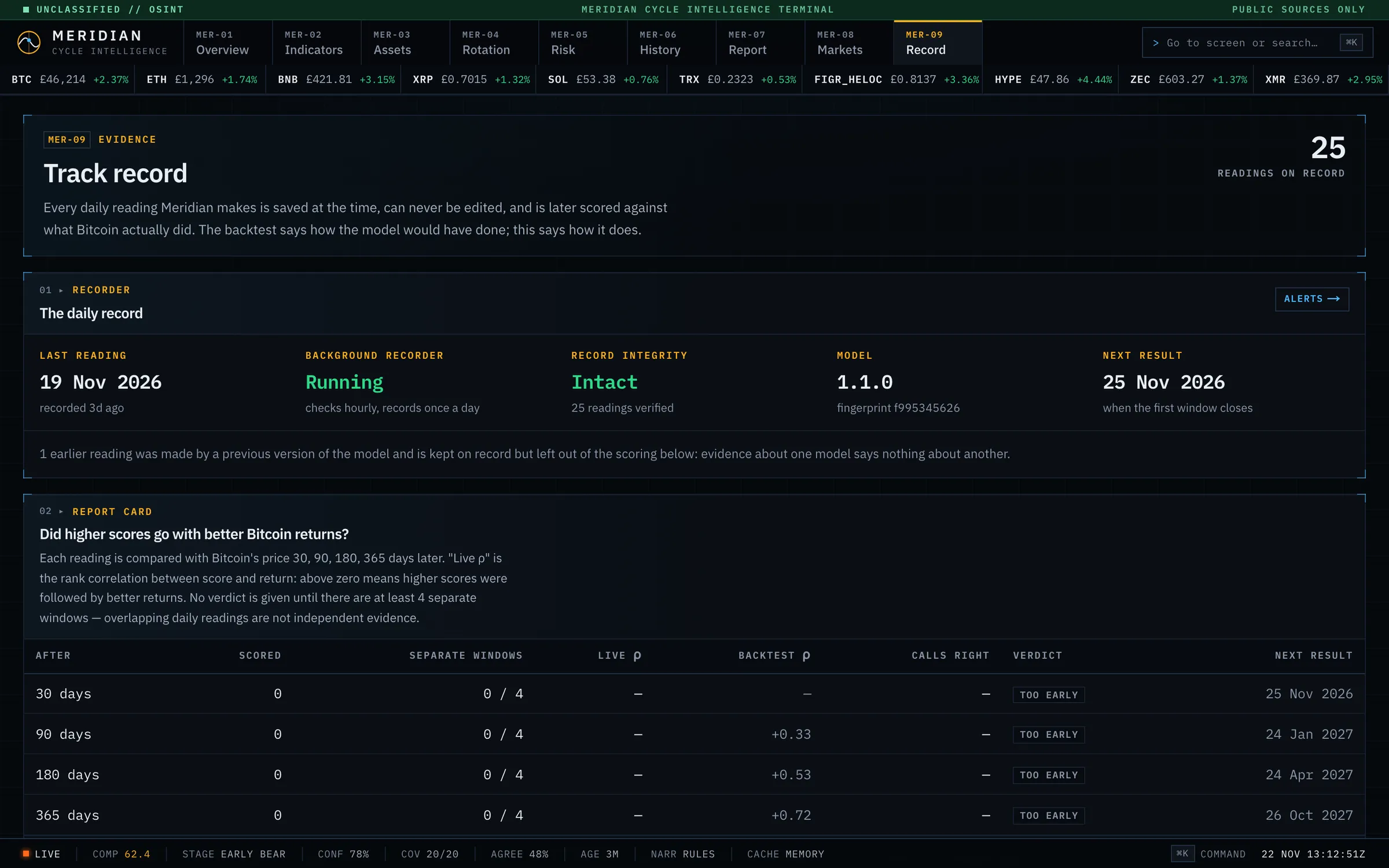
Crypto: one reading saved every day and never edited, so the track record builds honestly.
How I built it
Meridian started in June 2026 as one macro app, first called InvestmentTerminal. It tracks 42 US economic indicators from the Federal Reserve’s FRED database: over 100,000 monthly data points going back to 1990. It scores six pillars (growth, inflation, monetary policy, labour, energy and geopolitics) against their own history, and places the economy in one of six regimes, from Goldilocks to Stagflation. A global layer compares 15 countries and the Eurozone on World Bank data, on a 3D globe.
Equities applies the same idea to stock markets. It scores 8 national markets on six pillars as historical percentiles, which means “how does today compare with this market’s own past?” It then flows down to 89 stocks and 7 UCITS ETFs.
Crypto answers one question: where are we in the market cycle? It combines 20 indicators across 7 categories into a composite score and a probability across nine cycle stages. Since October 2026 it has recorded one reading a day. Its track record builds up in real time rather than being backtested after the fact.
Command reads the finished scores from the other three through one documented data contract. It never changes their numbers.
I wrote a master prompt for each app. It set out the questions the app must answer, the rules it must never break (no invented data, no hindsight in historical scores, free to run, information rather than advice) and the build phases. AI agents wrote the code: Claude Code on Macro, Cursor and Claude Code together on Crypto, and Cursor running Claude models on Equities and Command, with Gemini reviewing each phase independently. I approved each phase plan, tested every build and signed it off.
What I learned
- Provenance matters as much as the number. Every figure shows its source and how fresh it is, and missing data shows as a dash rather than a guess.
- Hindsight is the easiest way to fool yourself. A backtest that uses data nobody had at the time looks brilliant and means nothing. Meridian scores history only with what was known on the day.
- Data licences are part of the product. Some free crypto data is licensed for non-commercial use only, so Meridian Crypto has a switch that limits it to open data.
- A small contract beats a big rewrite. Command connects three separately built apps without touching their code.
Why it matters in a sales seat
My best results came from selling to heads of trading, portfolio managers and quant analysts. Building Meridian taught me how they read market data, and why they ask where every number came from.